Saint Pierre Church in France

Saint Pierre Church in France

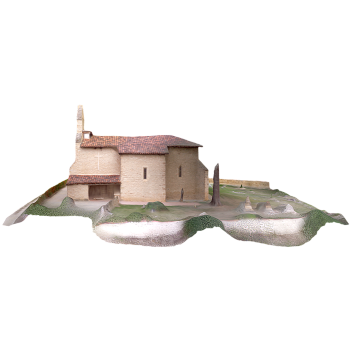
It is a Gothic building located in the Pyr é n é es department in eastern France, with a history dating back to the 17th century. It is a Gothic building located in the Pyr é n é es department in eastern France, with a history dating back to the 17th century. Construction began in 1606 and was not completed until 1696, replacing a smaller Romanesque church. The bell tower retains the Romanesque style, while the main building showcases the Gothic style of the 17th century. The interior decoration is magnificent, featuring a rich collection of artistic works and religious relics, including a large Baroque altar created by Catalan sculptor Joseph Sunier in 1699.
Proportional model of St. Peter's Basilica in Trier

Proportional model of St. Peter's Basilica in Trier

The Hohe Domkirche St. Peter in Trier is the cathedral of the Roman Catholic Diocese of Trier, measuring 112.5 meters (369 feet) in length and 41 meters (135 feet) in width, located in Trier, Germany. This church is the oldest cathedral in Germany, spanning over a decade and incorporating design elements from different generations.
Temple Bel

Temple Bel

The Temple of Bel is an ancient temple located in Palmyra, Syria. This temple was built to worship the god Bell of Mesopotamia, who was worshipped alongside the moon god Aglibol and the sun god Yarhibol in Palmyra, forming the center of Palmyra's religious life. The temple was built in 32 AD to offer sacrifices to the gods.
St Mary's Church

St Mary's Church

St. Mary's Church is a church located in Berlin, Germany. It is located in Karl Liebknecht Stra ß e (formerly Kaiser Wilhelm Stra ß e) in the center of Berlin, near Alexanderplatz. The original building age of this church is uncertain, but a record from 1243 mentions the location where a Jewish person was accused of stealing holy cakes. This church is also recorded in the German chronicles of 1292, suggesting that it was built in the early 13th century.
Carla Church

Carla Church

The Eglise du Carla church is located in the village of Carla in southern France, near the city of Tours. This church is a Roman Catholic building with a history dating back to the 15th century. The architectural style of this church is Romanesque, and it was built on an ancient Gallo Roman site.
Mauran Church

Mauran Church

The Mauran Church (Eglise de Mauran) is located in the village of Mauran in southern France, south of the city of Tours. This church is a Roman Catholic building with a history dating back to the 13th century. The architectural style of this church is Romanesque, and it was built on an ancient Gallo Roman site.
Tours Cathedral

Tours Cathedral

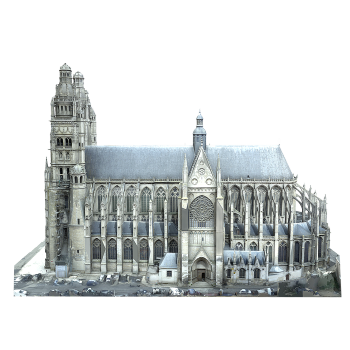
The Cath é drale Saint Gatien de Tours is a Roman Catholic church located in the city of Tours, France, built in memory of Saint Gatien. This church is the location of the Archbishop of Tours and the cathedral of the Diocese of Tours. Its construction began in 1170 and was completed in 1547.
Uppsala Cathedral supports Vision Pro visual experience

Uppsala Cathedral supports Vision Pro visual experience

Uppsala Cathedral is located in the city center of Uppsala in southeastern Sweden, between the main building of Uppsala University and the Firis River. This church is part of the Swedish State Church, a traditional Lutheran church, and also the location of the Archbishop of Sweden. In addition, this church is also the burial site of the Swedish national guardian saint and King Eric IX, who reigned from 1120 to 1160. The current Archbishop is Martin Modus, and the current Bishop is Karin Johanneson.
Opera National de Paris

Opera National de Paris

The Op é ra National de Paris is a representative opera and ballet troupe in France. The Paris National Opera was established in 1669 and is a public institution under the jurisdiction of the French Ministry of Culture. The performances at the Paris National Opera include works by masters such as Verdi, Bizet, Rossini, Mozart, Cavalli, Saint Sa ë ns, Offenbach, Enesco, Berlioz, and others.
Munich Copper City Model

Munich Copper City Model

Le Mont Saint Michel

Le Mont Saint Michel

Le Mont Saint Michel is a small island in the Normandy region of France and an important tourist attraction. This small island is famous for its magnificent monastery, built on a rocky hill surrounded by vast swamps and rapidly rising seawater. The history can be traced back to the 8th century AD, when it is said that Bishop Aubert built a small church here under the guidance of Archangel Michael.
The 19th century Jerusalem City Church supports Vision Pro visual experience

The 19th century Jerusalem City Church supports Vision Pro visual experience

In the 19th century, Conrad Schick praised the city of Jerusalem, and this cathedral is an important religious building in Jerusalem.
St. Peter's Church in Prades, France supports Vision Pro visual experience

St. Peter's Church in Prades, France supports Vision Pro visual experience

St. Peter's Church is an important building from the 17th century, built on the foundation of a Roman church, and today still retains the Lombard style bell tower from the 12th century. There are 14 small churches next to the nave of the church. The altar painting of the main altar, created by Catalan sculptor Joseph Sunyer in the late 17th century, is the largest Baroque altar painting in France.
Fort Pat é in France supports Vision Pro visual experience

Fort Pat é in France supports Vision Pro visual experience

Fort Pat é is a compact fortress located on a small island in the Gironde River. Along with Blaye's castle and M é doc's fortress, Fort Pat é can cut off water passages through crossfire. It was built between 1689 and 1693.
Hampton Court Palace Scene in the UK

Hampton Court Palace Scene in the UK

It is a historic palace in England, built in 1514 by Thomas Wolsey, the First Minister of Henry VIII. After losing favor, Wolsey presented the palace to Henry VIII in 1529 for forgiveness. Henry VIII was very fond of this palace and quickly arranged for its expansion to accommodate his large number of courtiers. In the early 1790s, William III carried out large-scale reconstruction and expansion work with the aim of rivaling the Palace of Versailles in France. However, this project was halted in 1694, resulting in the palace presenting two completely different architectural styles: Tudor and Baroque.
Westminster Palace Scene in the UK

Westminster Palace Scene in the UK

It is the location of the British government and a masterpiece of Neo Gothic architecture. This historic building not only carries the political activities of Britain, but also serves as an important cultural and historical landmark. Tourists can participate in guided tours on Saturdays and summers, visiting important places such as the House of Commons, House of Lords, Westminster Hall, Big Ben, Blackcane Garden, Victoria Tower, Old Palace, Speaker's Residence, Speaker's Green, St. Stephen's porch, St. Stephen's Hall, and New Palace. These locations not only showcase the parliamentary system of the UK, but also symbolize British democracy and political life.
Windsor Castle Scene in England

Windsor Castle Scene in England

It is a royal residence located in Windsor, Berkshire, England. Closely connected to the British royal family, it has almost carried a thousand years of architectural history. Founded in the 11th century, it was built by William the Conqueror after the invasion of England in Normandy. Since the reign of Henry I (1100-1135), it has been used by reigning monarchs and is the longest occupied palace in Europe. Inside the castle walls, there is also the 15th century St. George's Church, which historian John Martin Robinson considers to be "one of the outstanding achievements of British vertical Gothic design".
Historic Tower in Romania

Historic Tower in Romania

It is a historic tower located in the center of T â rgovi ș te, Romania, belonging to the Curtea Domneasc ă architectural complex. Founded in the 15th century, it was built by Vlad Dracul and his son Vlad Ț epe ș (the legendary vampire Count Dracula). Originally used as a bell tower, it later evolved into a defensive and alert function. In the 17th century, the tower was transformed into an astronomical tower. In the mid-19th century, Prince Gheorghe Bibescu initiated a reconstruction, restoring and transforming it into a fire alarm tower.. The tower is now one of the historical monuments in Romania.
19th to 20th century railway station restaurants

19th to 20th century railway station restaurants

This historic railway station restaurant from the 19th to the 20th century has now fallen into ruins and been abandoned in the dust of history. The exterior walls are white and cracked concrete, and the roof is damaged, revealing the traces of time. Once upon a time, this place may have been a bustling place where people dined, socialized, and enjoyed a nap during their travels. However, over time, it gradually lost its former glory and became a dilapidated place, witnessing the changes of an era. Nevertheless, its existence still attracts those interested in history and architecture, who search for past stories and traces of time here.
Tower of London, UK

Tower of London, UK

It is a historic building in London, England, built in the 11th century and ordered by William I. It is not only a royal palace, but also a prison, fortress, arsenal, mint, royal zoo, and national monument.. The most famous building of the Tower of London is the White Tower, which is an outstanding representative of medieval military architecture and the core of the entire Tower of London complex. Witnessing the historical changes of Britain, it was once a symbol of royal power and a venue for political struggles. Nowadays, the Tower of London is a popular tourist attraction with a collection of gems from the British Crown, attracting thousands of visitors every year.
St. Albans Cathedral in England

St. Albans Cathedral in England

The official name is St. Alban Cathedral and Abbey Church, but locals commonly refer to it as a "monastery". It is an English church cathedral located in St. Alban, England. Built in the 8th century, the existing buildings are Norman or Romanesque from the 11th century, and also include Gothic and 19th century additions. Most of the buildings in the church can be traced back to the Norman period. After its dissolution in the 16th century, it ceased to be a monastery and became a cathedral in 1877. The church is 85 meters long and is the longest nave among all cathedrals in England.
Irmenakh Blacksmith Shop - Roshdhof Open Air Museum

Irmenakh Blacksmith Shop - Roshdhof Open Air Museum

The building located on the edge of the village of Irmenakh was originally an ordinary Japanese workshop. It was not until the last owner passed away in 1928 that it was transformed into a blacksmith shop. It showcases the nail blacksmith shop in the Hunsluck region of the 1930s, which produced nails for carpenters, roofers, and shoemakers. This building, built in 1807, was originally used as a simple residence. Nowadays, tourists can visit this building at the Roshdhof Open Air Museum.
Old railway stations in Germany from the 19th to the 20th century

Old railway stations in Germany from the 19th to the 20th century

They are representatives of historical architecture in Germany from the 19th to the 20th century, witnessing the rise and development of railway transportation. Usually using classic brick and stone structures, its facade is decorated with exquisite brick carvings and concrete details. Over time, some stations have been abandoned and become dilapidated due to various reasons. The stations in these ruins, despite cracked walls and peeling concrete, still retain a unique beauty and historical value. Not only is it a witness to history, but it has also become a hot spot for photography enthusiasts and urban explorers to explore, allowing people to feel the passage of time and the weight of history in these forgotten corners.
Castle of Veves

Castle of Veves

Ch â teau de V ê ves is located in Celles, one of the most beautiful villages in the Walloon district. The appearance of this castle resembles a castle in a fairy tale, and it is also considered one of the most beautiful medieval castles in Belgium and a special heritage of the Walloon region. The castle was destroyed in 1200, rebuilt in 1230, burned down again in the early 15th century, and rebuilt after a fire. Until the end of the Middle Ages, this castle remained a military fortress. It consists of five towers and an extraordinary half timbered structure dating back to the 16th century.